Views: 0 Author: Christine Troutman – Director of Scientific Operations Publish Time: 2026-04-21 Origin: Site
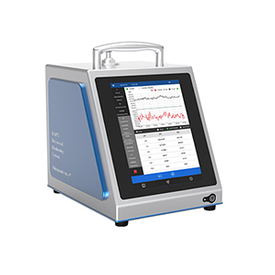
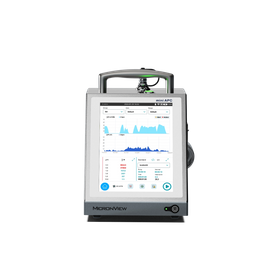
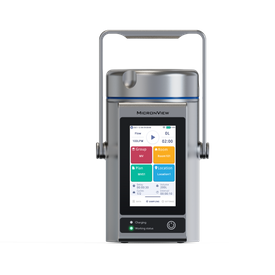
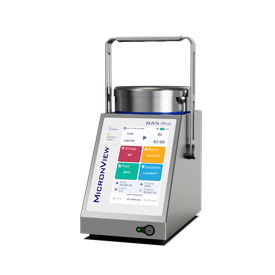
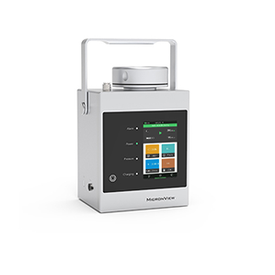
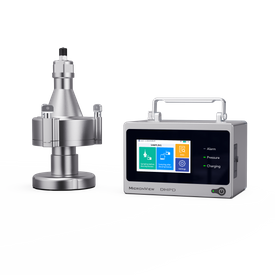
MicronView has launched a 0.1 µm Airborne Particle Counter (APC) designed for cleanroom environments where submicron contamination is a critical process variable.
Most cleanroom monitoring programs are built to detect ≥0.5 µm particles, because this threshold aligns with GMP frameworks and standard classification practices. That approach remains appropriate for many applications, but it does not fully represent the particle population in environments where smaller particles influence yield, surface quality, or device performance such as in the semiconductor manufacturing industry.
Accurate detection at 0.1 µm requires higher optical sensitivity and tighter control of instrument noise, which has historically limited its use. As process tolerances continue to tighten, that level of measurement is becoming more relevant.
MicronView's 0.1 µm APC extends measurement capability to the submicron level, while maintaining the sampling flexibility required for both classification and routine monitoring.

0.1µm APC: Key Features and Specifications
System Configuration
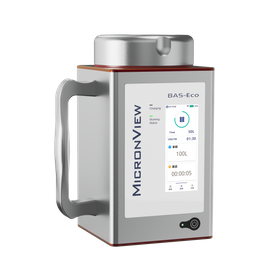
The 0.1 µm APC is available in two models, allowing for alignment with distinct sampling strategies and cleanroom requirements rather than forcing a single approach.
| Specification | Model: A010 | Model: A030 |
| Flow rate | 10LPM±5% | 28.3LPM±5% |
| Size channels | 0.1, 0.2, 0.3, 0.5, 0.7, 1.0 µm | 0.1, 0.2, 0.3, 0.5, 1.0, 5.0 µm |
| Application Suitability | Optimized for low-concentration high-sensitivity detection with lenient sampling time limits. | Compliant with standard cleanroom sampling volumes, supporting classification workflows and a broader range of size channels. |
Counting Efficiency and Measurement Considerations
Performance at 0.1 µm comes with a different set of expectations compared to conventional particle counting. MicronView's 0.1 µm APC meets these expectations with:
- Count efficiency of 50% ±20% at 0.1 µm
- 100% ±10% count efficiency for particles above 0.15 µm
- Size resolution of <15% at 0.2 µm
- Internal HEPA-filtered exhaust to prevent local re-contamination (≥99.999% filtration efficiency for particles ≥ 0.1 µm)
The 0.1 µm channel is most useful for trending and identifying relative changes in particle populations over time. It adds visibility into submicron behavior, but like any measurement at this size range, it needs to be interpreted with an understanding of count efficiency and background signal at the smallest size channel.
Sampling Strategy and Data Integrity
From a workflow perspective, the system is designed to handle both discrete classification activities and longer-term monitoring without requiring a change in platform. MicronView's 0.1 µm APC features include:
- Programmable sampling plans with location-based recipes and configurable cycles, intervals, and delays
- Support for short-duration classification sampling and extended monitoring
- Large data storage capacity for trending and analysis
- Exportable reports aligned with ISO-based formats
- Audit trail and permission structure for controlled environments
In practice, this allows the same instrument to move between qualification work, routine monitoring, and investigation without needing to be reconfigured.
Software Integration
The 0.1 µm APC can be operated as a standalone instrument or integrated into a broader data management workflow, depending on facility requirements. Its key features include:
- Compatible with MicronView Portable EMC Software for centralized, consistent deployment of sampling protocols across devices.
- Supports one-time shared configuration of sampling locations, recipes, cycles and thresholds to minimize variability between operators and instruments.
- Achieves integrated data collection, review, analysis and regulatory-compliant report export.
- Equipped with complete audit trails and user-level access control to maintain strict data integrity.
- Compatible with existing environmental monitoring platforms to achieve submicron data integration without modifying original monitoring infrastructure.
Deployment Strategy: Portable vs Automated Sampling
The 0.1 µm APC can be deployed as a standalone instrument or integrated into an automated monitoring system, serving as a flexible solution for facilities of all sizes and complexity levels.
Portable Operation
In standalone mode, the APC functions as a standard cleanroom particle counter with extended sensitivity, offering:
- ISO-based classification and requalification
- Tool-level or zone-specific investigations
- Troubleshooting excursions or abnormal trends
- Flexible, location-based sampling
Sampling plans can be defined at the device level or shared across multiple devices, which helps maintain consistency even in manual workflows.
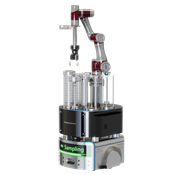
Automated Sampling with EMC Robot

For environments where sampling needs to be consistent across many locations, the APC can be integrated with MicronView's EMC Robot platform, offering:
- Navigation to predefined sampling locations
- Execution of repeatable sampling routines with fixed positioning
- Elimination of operator variability
- Reduced personnel presence in critical environments
- Continuous operation with automated charging
In high-grade cleanrooms, operator presence is not neutral. It is a measurable source of particles, so removing that variable improves both data quality and environmental control. The future of environmental monitoring lies in automation, and ultraclean environments are a great example of where this technology could be a benefit.
Application Focus: Where Submicron Monitoring Becomes Critical
Monitoring particles down to 0.1 µm matters most when submicron particles are tied to process performance.

Semiconductor Manufacturing
Front-end wafer fabrication processes operate at feature sizes where particles well below 0.5 µm can directly affect device integrity. Failure modes at this scale include pattern disruption, bridging, and localized defects, all of which can be driven by particles that are not captured in standard ≥0.5 µm detection strategies.
ISO 14644-1 defines particle concentration limits down to 0.1 µm for ISO Class 1 through 6 cleanrooms, which are commonly used in semiconductor manufacturing. In these environments, monitoring programs are typically built around these classification requirements and then refined based on process sensitivity, tool specifications, and yield performance. This often results in the inclusion of submicron particle monitoring to provide additional visibility into contamination risks.
Advanced Electronics and Precision Manufacturing
In environments where surface quality or optical performance is critical, submicron particles can introduce defects that are not visible in standard particle datasets. Optical systems are increasingly sensitive to scattering at smaller particle sizes, and tolerance limits often exceed what ISO classification alone would require.
These environments are not always operated at the highest ISO cleanroom classes, but the products themselves can still be highly sensitive to very small particles. As a result, monitoring programs are often defined by product-specific contamination risks rather than cleanroom classification alone. In practice, this can include monitoring at 0.1 µm to provide better visibility into submicron particles that could impact surface quality or performance, even when it is not explicitly required by ISO limits or regulatory frameworks.
Pharmaceutical Environments
From a regulatory standpoint, 0.1 µm monitoring is not commonly required.
GMP frameworks focus on ≥0.5 µm and ≥5.0 µm particles for classification and routine monitoring, reflecting historical alignment with viable contamination risk rather than the full particle distribution.
Submicron data can still be useful in process development, advanced therapy manufacturing, or the investigation of atypical particle trends. In these cases, the value is analytical rather than compliance driven.
Standards and Regulatory Context
ISO 14644-1 is the primary standard that defines particle concentration limits at 0.1 µm.
- Applicable to ISO Class 1 through 6
- Widely used in semiconductor cleanroom classification
ISO defines allowable concentrations, but it does not prescribe how monitoring should be implemented. Sampling locations, frequency, and size channels are typically determined based on process risk rather than minimum compliance.
Other regulatory frameworks do not extend to 0.1 µm, which is why adoption is concentrated in industries where process sensitivity justifies it.
When 0.1 µm Monitoring Is Needed
0.1 µm monitoring is not a default requirement. It becomes relevant when submicron particles are part of the potential failure of the process.
It is most appropriate when:
- Submicron particles are linked to yield or product performance
- ISO Class 1 to 6 environments are in use
- Additional resolution is needed to understand particle behavior
It is less relevant when monitoring is driven strictly by GMP compliance and particle sizes of concern are ≥0.5 µm, unless there is a specific process-driven risk.
Key Takeaways
The 0.1 µm APC extends particle counting into a range that is increasingly relevant in advanced manufacturing, adding resolution where it is needed without changing the overall workflow.
With both 10 LPM and 28.3 LPM configurations, structured sampling capabilities, and the option for full automation through the EMC Robot platform, MicronView's 0.1µm APC can be deployed in a way that aligns with existing monitoring strategies while providing a more complete dataset for environmental control and process optimization.