Views: 0 Author: Christine Troutman – Director of Scientific Operations Publish Time: 2026-08-12 Origin: Site
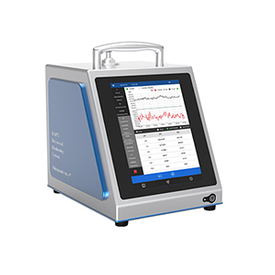
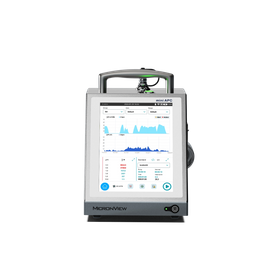
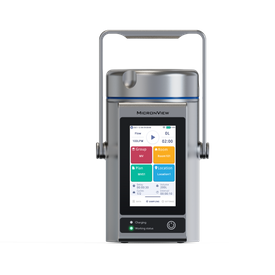
A modern portable particle counter does a great deal on its own. MicronView's mini APC configures its own sampling plans, stores thousands of records on board, keeps its own audit trail, and exports its data directly. For a single instrument, that is often everything you need.
Monitoring programs rarely stay at a single instrument. As a program grows to several counters running across many rooms and generates a growing volume of data, the work shifts from operating an instrument to managing a fleet. Handled device by device, each instrument is its own island, with its own export, its own settings, and its own slice of the overall picture. Bringing all of that together, keeping it consistent, and turning it into something you can trend and defend is where a per-device approach starts to cost real time.
That is the gap MicronView's Portable EMC System is built to close. It works alongside the software on each instrument, giving a whole fleet of portable devices one set of sampling plans, one place for the data to live, and one audit-trailed system of record.
Managing Data Instrument by Instrument: The Limitations
The limitations of a per-device approach become clear when a monitoring program expands to manage many instruments and large datasets.
The first issue is fragmentation. When each device holds and exports its own data, a facility-wide view has to be assembled by hand, one file at a time. Reconciling a dozen separate exports into a single picture of the week is tedious, and every manual merge is a chance to misplace or mislabel a dataset. The correct information exists in various pieces, but the problem lies in making the fragments whole in an accurate and efficient way.
The second issue is consistency. A monitoring program depends on every instrument running the same plan, on a set of different or the same locations, with the same thresholds. Configuring each device individually and updating each one by hand whenever a plan changes, invites drift. Over time, ten instruments quietly become ten slightly different interpretations of the program, which is exactly the kind of inconsistency an auditor is trained to find.
The third is analysis. Trending and statistics are most useful across rooms and across time, not one instrument at a time. Doing that from separate per-device exports means stitching files together before the real work of interpretation can even begin, so trending tends to happen late, if it happens at all.
Instruments also vary in what they can do on their own. Some portables on the market offer limited export or thin audit-trail capabilities, which makes managing them individually harder still.
MicronView's Portable EMC Software: The Solution
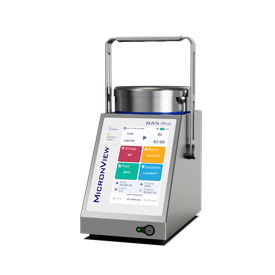
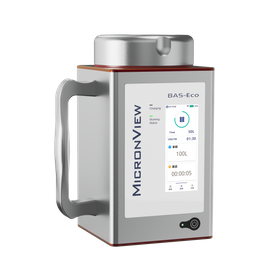
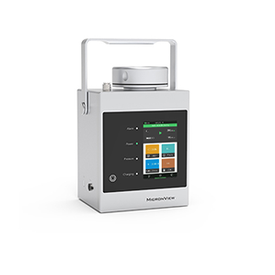
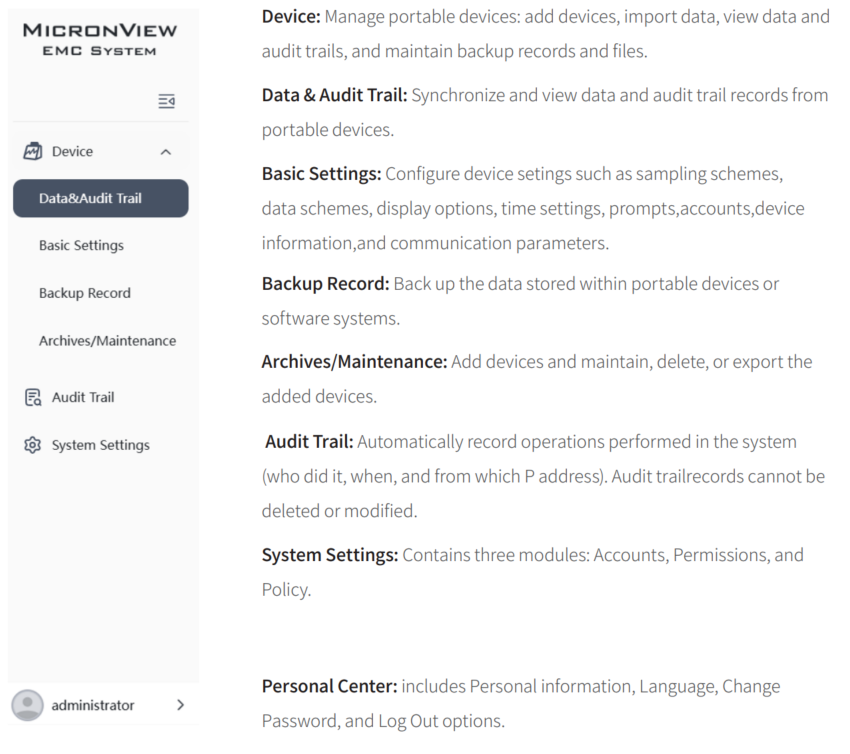
MicronView's Portable EMC Software is a management layer that sits above the software already on your portable MicronView instruments. It is a browser-hosted platform that installs locally on a standard Windows PC, with no cloud connection required and full ownership of your data. It connects directly to your portable counters over a wired or wireless network, including the full mini APC line (models A210 through A242) as well as certain models of BAS and BAMS. Rather than each counter being an island, the fleet becomes a single managed system.
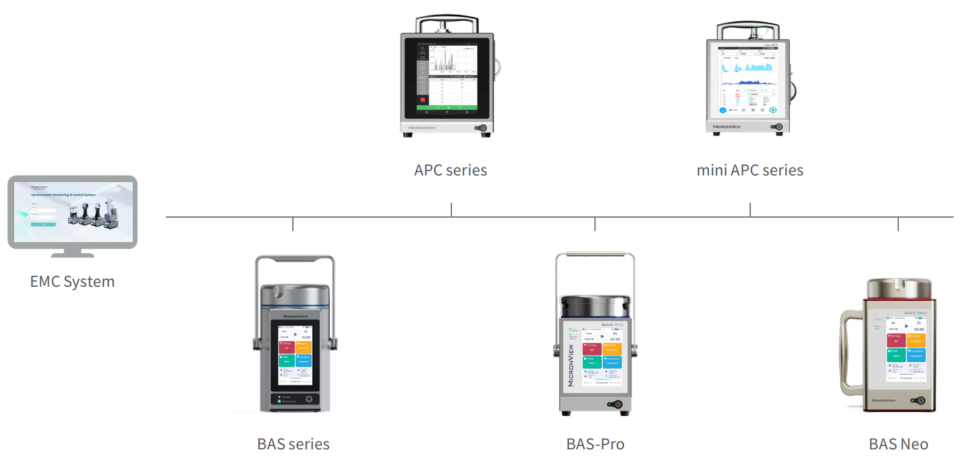
Centralized sampling plan management. You build your monitoring program once, as structured zones, recipes, and threshold schemes. Each location carries its own name, description, sampling parameters, alert level, and action limit. That plan then exports as a template and pushes to every matching device on the floor. A ten-instrument fleet runs one consistent, version-controlled program instead of ten configurations maintained by hand, and a change made once propagates everywhere.
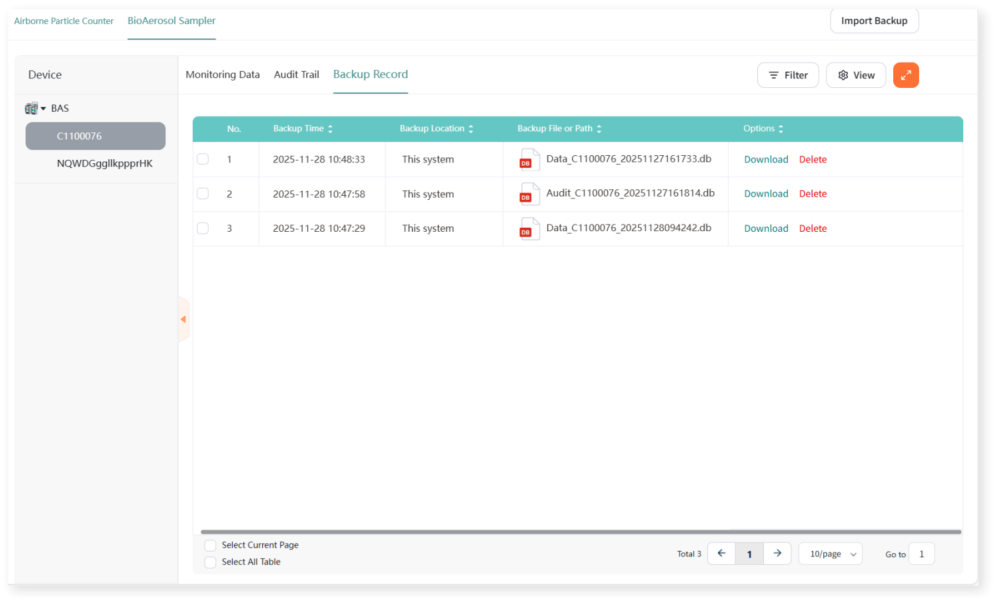
Aggregated data management. Data from every connected device synchronizes into one system, already sorted by zone and location, so the facility-wide picture assembles itself instead of being merged by hand. The transfer is one-directional by design (device to system) so the record of what each instrument measured is preserved rather than overwritten, and a simple status indicator shows at a glance which devices are current, and which still have data to come across.
A system-level audit trail. Beyond the audit trail each device keeps, the EMC System logs every action taken within it, from login to logout, from adding a record to modifying, deleting, or exporting one, with the operator, their ID, the time, and the originating IP address. Those records cannot be edited or deleted. The trail is filterable, accepts remarks for context, and exports as a report on demand. Managing a program to the data-integrity expectations of 21 CFR Part 11 is far more practical when the whole fleet's activity is captured in one place.
User management and access control. The system runs on role-based permissions, with a configurable password policy governing complexity, length, and expiration, applied consistently across every instrument in the program. A lab tech, a reviewer, and a QA manager each see and do exactly what their role allows, and every action stays attributable to a named user, which is the backbone of the “attributable” in ALCOA.
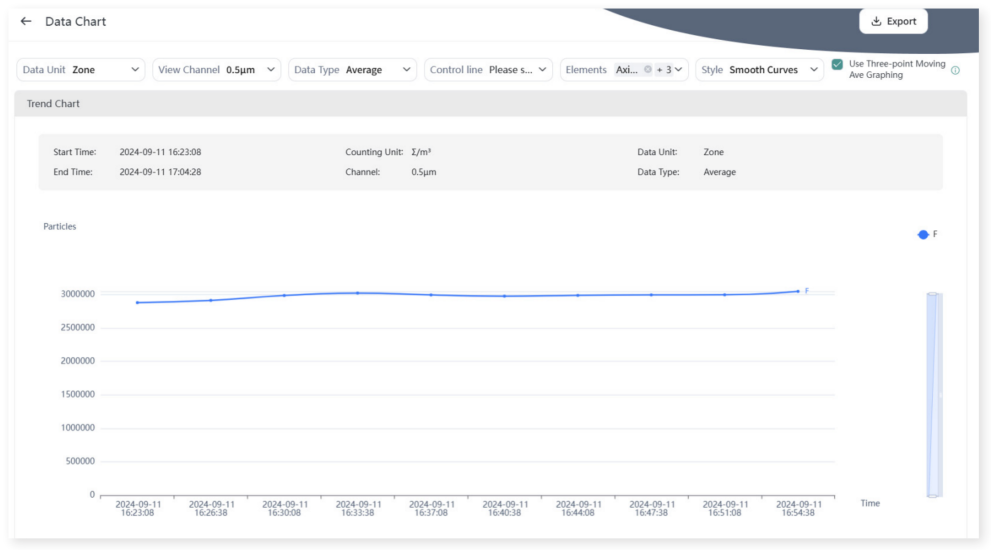
Fleet-wide analysis and reporting. With the data centralized, built-in statistics are available for any dataset, including average, maximum, 95% upper confidence limit, standard deviation and standard error, alongside automatic trend analysis with a three-point moving average, graphed by zone or by location and across instruments. Standardized reports export in one click to PDF or Excel from templates you define once, complete with signature fields, timestamps, and the particle-size channels, thresholds, and statistics you choose.
Portable EMC Software in Practice
The value of this system is made clear in the context of the real rhythm of a program. The scenarios below trace how the EMC System and a fleet of mini APCs handle situations that get harder as the number of instruments and the volume of data grow.
Routine monitoring across a cleanroom suite. A facility runs a daily route across a dozen rooms with dozens of non-viable points each, split between two or three technicians carrying mini APCs. Every instrument is loaded from the same exported sampling plan, so the zones, locations, sampling order, and per-location action limits are identical no matter who is sampling or which device they picked up that morning. As each technician finishes, they dock their instrument and sync, and within minutes the whole day's counts across every room sit in one system, already sorted by zone and location, rather than trapped in three separate device exports waiting to be merged. If one device still shows an orange indicator, you know at a glance whose data has not come across yet, instead of discovering the gap during the monthly review.
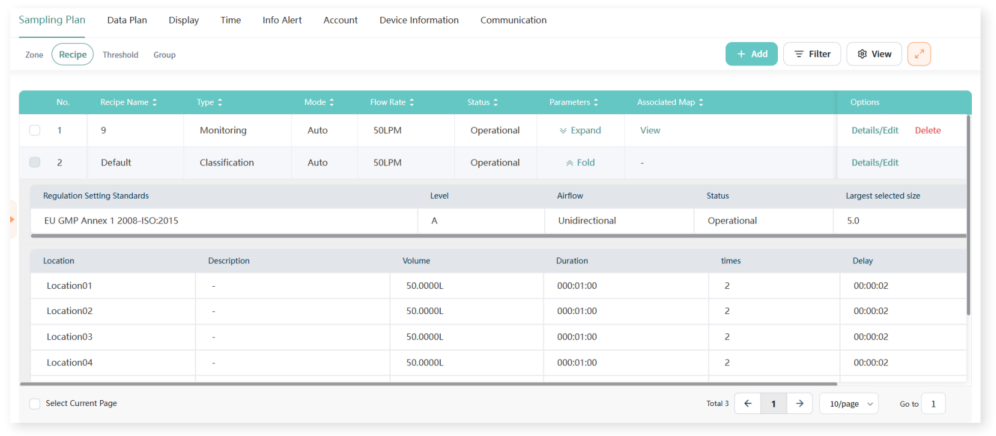
Standardizing and onboarding instruments. A program buys a fourth mini APC, or sends one out for calibration and swaps in a spare. Instead of hand-configuring the new unit and hoping it matches, you export the basic settings, sampling plans, data plans, thresholds, display and alarm configuration, as a template and import it onto the new device with a few simple clicks. It joins the route already running the same version-controlled plan as the rest of the fleet. The same mechanism keeps a growing program consistent as it scales, with no drift between devices creeping in over time.
Investigating an excursion. A Grade C location comes back over its alert level. Working from per-device exports, the investigation starts by finding and reassembling the relevant history by hand. In the EMC System you pull that location's trend directly, the three-point moving average graphed over weeks, and see immediately whether this is a one-off spike or the tail of a slow upward drift that should have been caught earlier. The audit trail tells you who sampled it and when, filtered to that point in seconds, and the statistics for the location are already calculated. You are investigating the event rather than reconstructing the record around it.
Preparing for an audit or inspection. An inspector asks for the last quarter of monitoring data for a specific suite, with proof the records are intact. Instead of gathering exports from several instruments and stitching them together, you filter the centralized data to the suite and date range, export a standardized report to PDF with the channels, thresholds, statistics, and signature fields already configured, and export the audit trail alongside it showing every action taken on that data. The request that once meant a day of collating device files is answered in the room, while the inspector waits.
Multi-site and shared environments. In a contract or multi-team facility, several groups may run monitoring on the same platform. Role-based permissions keep each person's access scoped to what their job requires, a technician records and syncs, a system admin adds new personnel, a QA manager exports a new sampling scheme to devices, and every action is attributable to a named user. Because the system installs locally with no cloud dependency, the facility keeps full ownership and control of its data, which matters when that data is the evidence a product release rests on.
Regulatory Context
Regulatory bodies are increasingly expecting and rewarding this kind of centralization. The revised EU GMP Annex 1 expects contamination control to be designed into a facility and demonstrable in real time, built on a documented, risk-based strategy. As a program scales, that expectation is far easier to meet when sampling plans, data, and audit trails for the whole fleet are managed in one place than when they are spread across individual instruments and their separate exports.
Operating a single counter and managing a monitoring program are different tasks. The instrument captures the data; a centralized system keeps that data coherent across the fleet as the program grows, which is what keeps trending, investigation, and inspection-readiness sustainable at scale.
The Bottom Line
A portable particle counter, and the software on it, gives you good data one instrument at a time. A monitoring program needs that data managed across every instrument, kept consistent, trended, and ready to defend. The EMC System is the layer that does that, so a growing fleet of portable devices behaves like one coordinated program instead of a collection of separate islands.
The mini APC and the EMC System are designed to work together this way: instruments portable enough to carry through a full route, and a management program centralized enough that the data they produce stays manageable no matter how much of it there is.