Views: 0 Author: Christine Troutman – Director of Scientific Operations Publish Time: 2026-01-07 Origin: Site

Contamination investigations are rarely theoretical exercises. They happen mid-shift, under production pressure, with QA, operations, and manufacturing all waiting for answers. In cleanroom environments, even a single excursion can trigger immediate concern around product impact, personnel practices, and facility control.
Most facilities rely on well-established growth-based environmental monitoring methods. These methods are validated, understood, and the long-standing gold-standard for EM programs. But when it comes to investigating contamination events, timing and accuracy are vital to ensure any potential risk is understood and controlled.
This example walks through how a realistic Grade B contamination event is investigated using traditional CFU-based methods, and how that same event would be handled with a Biofluorescent Particle Counter instead.
| EXAMPLE SCENARIO OVERVIEW |
Consider a Grade B cleanroom supporting Grade A aseptic operations. The room is active throughout the day and plays a critical role in maintaining aseptic conditions upstream of filling or processing. Typical activities include:
- Routine personnel entry and exit
- Material transfers through airlocks
- Cleaning and disinfection between operations
- Background support for Grade A zones
The environmental monitoring program is well designed and compliant, and includes:
- Active viable air sampling at defined locations during the shift
- Passive settle plates placed during operations
- Periodic non-viable particle monitoring
On the day in question, nothing appears out of the ordinary. No alarms sound. No visible breaches occur. Production proceeds as planned.
| A CONTAMINATION EVENT OCCURS |
At some point during the shift, a biologic contamination event occurs. This could be caused by something relatively minor and transient, such as:
- A brief gowning or glove disturbance
- Increased personnel movement in a short time window
- An incorrect material transfer that disrupts airflow
- A short-lived HVAC or pressure fluctuation
Critically, using the current EM program, no one is aware that this event has happened. There is no immediate signal that contamination has entered the air.
This is the starting point for most contamination investigations, even though it is rarely recognized as such at the time.
| INVESTIGATING CONTAMINATION WITH TRADITIONAL GROWTH-BASED METHODS |
Traditional viable air sampling remains essential for microbial recovery and identification. However, because results require incubation, investigations begin after the contamination event has already passed.
Detection: when you learn there may be an issue
The first indication that something went wrong usually occurs 2 to 5 days after the contamination event, when viable air sample plates complete incubation and are read.
At that point, a result from the Grade B room exceeds an alert or action limit.
This result confirms that contamination occurred, and when, but not necessarily why.
Context: what you know at that moment
When the result becomes available, you know that contamination occurred at some point during the sampling window, but you do not know:
- The exact moment the event occurred
- Whether it was brief or sustained
- Whether it resolved on its own or persisted
- The source of the contamination
By the time the result is known, the room conditions, personnel, and activities associated with the event no longer exist.
Root-cause analysis: how investigations proceed in practice
QA opens an investigation and the team attempts to reconstruct the event using indirect and retrospective data. Root-cause analysis focuses on identifying plausible contributors rather than directly observing the cause.
Typical investigation steps include:
- Batch record review for the affected shift
- Personnel entry and exit logs
- Gowning records and observations, if available
- Cleaning and disinfection records
- HVAC, pressure, and environmental trend review
- Non-viable particle data from the same day, if it exists at the relevant time
Additional sampling may be scheduled, but it reflects current conditions, not the conditions that existed when the contamination occurred.
Because multiple activities often take place during a viable sampling window, root-cause conclusions are frequently limited to contributing factors rather than a definitive cause.
Impact: how timing uncertainty affects production decisions
Because the “when” and “why” might remain unclear, investigations often become broader than necessary. Facilities may:
- Expand the investigation scope to adjacent areas or additional shifts
- Increase sampling frequency for a defined period
- Place batches on hold pending further assessment
- Implement broad corrective actions driven by uncertainty
Even with strong documentation and experienced teams, investigations often conclude with “probable cause” or “root cause not definitively determined” because the data does not support a more specific conclusion.
| BIOFLUORESCENT PARTICLE COUNTERS AS ALTERNATIVE INVESTIGATIVE TOOLS |
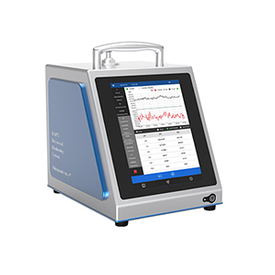
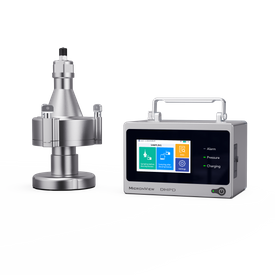
Biofluorescent particle counters (BFPCs) are instruments that analyze particles in the air in real time and determine which particles are likely biological by measuring fluorescence characteristics associated with microorganisms. Simultaneously, they count and size all particles similarly to a standard non-viable particle counter.
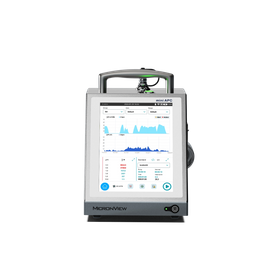
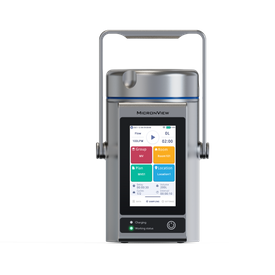
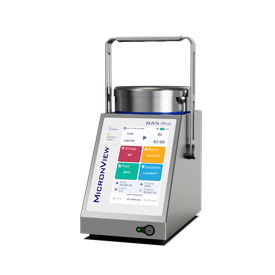
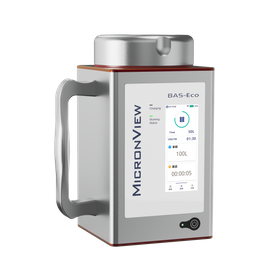
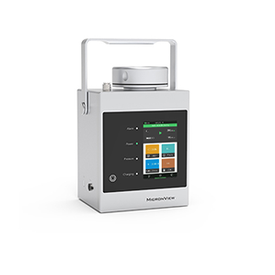
MicronView’s BAMS is a BFPC designed for pharmaceutical cleanroom monitoring. Instead of waiting days for colony growth, it provides continuous biofluorescent particle information during operations in real time.
This does not replace growth-based methods for identification. What it changes is awareness and response time. With a BAMS used in the same Grade B room, contamination events can be detected as they occur, preserving timing and operational context.
Detection: when you learn there may be an issue
BAMS detects an increase in biofluorescent particles during the actual contamination event. Alerts can be generated in real time, while the room conditions are unchanged.
Context: what you know immediately
At the time of detection, teams can immediately determine:
- The time the event began
- The duration of the event
- Whether it resolves quickly or persists
- Whether it is a single transient spike or a recurring condition
This timing context fundamentally changes the investigation starting point.
Root-cause analysis: moving from reconstruction to correlation
Because detection is real time, root-cause analysis becomes correlation-based rather than assumption-based. Teams can directly evaluate what was happening at the moment the signal occurred, such as:
- Personnel entry or exit
- Gowning or glove adjustments
- Specific material transfers
- Cleaning or disinfection activities
- Process step transitions
BAMS also allows operators to actively investigate during the event by:
- Scanning different areas using “beep” mode to localize the source of increased biologic counts
- Observing whether biofluorescent counts follow personnel or remain fixed to a location
- Determining whether the signal resolves once an activity stops
This enables teams to distinguish between:
- A one-time human-factor event
- A procedural weakness
- A localized environmental issue
- A recurring operational pattern
Actions: what you can do immediately
Because the investigation happens in real time, responses can be targeted and proportionate:
- Pause or limit activities if appropriate
- Perform immediate localized cleaning
- Increase monitoring in specific locations or around specific operations
- Deploy confirmatory viable air sampling intentionally at the time of the event
- Escalate to QA with time-stamped, contextual data
Traditional viable sampling remains essential, but it now supports confirmation and identification rather than discovery.
Impact: how real-time root-cause insight changes decisions
With time-correlated data, teams can often:
- Narrow batch impact assessments to a specific window
- Reduce investigation scope and duration
- Implement corrective actions aligned to the observed cause
- Resume operations sooner with higher confidence
This approach does not reduce regulatory rigor. It improves the quality and defensibility of decisions.
| CONCLUSION |
In contamination investigations, the difference between delayed confirmation and real-time awareness has meaningful operational consequences. Traditional growth-based methods remain essential for recovery and identification, but their inherent time lag often forces teams to investigate retrospectively, with limited context and greater uncertainty. By contrast, biofluorescent particle counters like BAMS shift investigations upstream, preserving timing, activity, and environmental context at the moment an event occurs. Used alongside established viable methods, real-time biofluorescent monitoring enables faster, more focused root-cause analysis, more proportionate corrective actions, and more confident production decisions without compromising regulatory rigor.